

Bringing full-time domestic help into your home promises relief from the relentless demands of household upkeep. Yet many homeowners find the reality more complicated than expected. Without clear systems in place, even the most willing live-in housekeeper can fall short of your standards, not through lack of effort, but through lack of direction. The good news is that learning to maintain cleanliness with live-in help is far more about structure than supervision. This guide walks you through everything from contracts and onboarding to routines, communication, and protecting your helper's wellbeing so that high standards become the norm rather than the exception.
Table of Contents
- Key takeaways
- Preparing your home before live-in help arrives
- Building structured cleaning routines
- Communication and performance verification
- Protecting your helper's wellbeing
- Common mistakes that undermine cleanliness
- My perspective on what actually works
- How Michelleandcohousekeeping supports homeowners
- FAQ
Key takeaways
| Point | Details |
|---|---|
| Contracts set the foundation | Signed agreements covering duties, hours, and accommodation prevent disputes before they start. |
| Systems beat supervision | Labelled supplies, visual checklists, and room maps help helpers work independently and consistently. |
| Routines must be structured | Dividing tasks by daily, weekly, and occasional frequency prevents overload and inconsistent results. |
| Communication prevents failure | Weekly check-ins and clear escalation points resolve issues before they affect cleanliness standards. |
| Wellbeing sustains quality | Protecting rest days and workload balance reduces burnout and keeps performance consistently high. |
Preparing your home before live-in help arrives
The single most common reason live-in arrangements fail is not incompatibility. It is inadequate preparation. Before your live-in housekeeper sets foot through the door, the groundwork needs to be solid.
Start with a signed contract. Employment contracts and safety agreements are non-negotiable. They clarify duties, protect both parties, and remove ambiguity about what is expected from day one. A thorough contract should cover job duties, working hours, on-call arrangements, accommodation conditions, and notice and termination policies. Without this, even the most straightforward disagreement can escalate quickly.
Accommodation matters more than most homeowners realise. Your helper's living space should be private, well-furnished, and compliant with basic standards. A comfortable, respected helper is a motivated one.
Beyond the legal and logistical basics, your home itself needs to be set up for success:
- Label all cleaning products clearly, including which rooms or surfaces each is intended for
- Create a simple storage map so your helper knows where everything lives without having to ask
- Prepare a house rules document covering areas such as guest rooms, personal spaces, and fragile items
- Establish rest days and working hours in writing before the first day begins
- Plan a room-by-room walkthrough for the first day, covering your standards for each space
Pro Tip: Onboarding guides recommend that with the right preparation, including visible checklists, labelled supplies, and a thorough house walkthrough, a new helper can reach full independence within the first week. Front-load your effort here and you will save weeks of correction later.
The table below outlines what to prepare before your helper's first day:
| Preparation area | What to do |
|---|---|
| Legal documentation | Sign employment contract and safety agreement covering all duties and hours |
| Accommodation | Provide private, furnished room with adequate storage and privacy |
| Cleaning supplies | Label all products and create a storage map for each area of the home |
| House rules | Prepare a written document covering personal spaces, fragile items, and guest areas |
| Onboarding plan | Schedule a room-by-room walkthrough and set expectations for the first week |
Building structured cleaning routines
Cleanliness is a systems problem, not a motivation problem. Once you accept that, everything else becomes much easier to manage. The most effective household tidiness solutions are built around task frequency, not task volume.
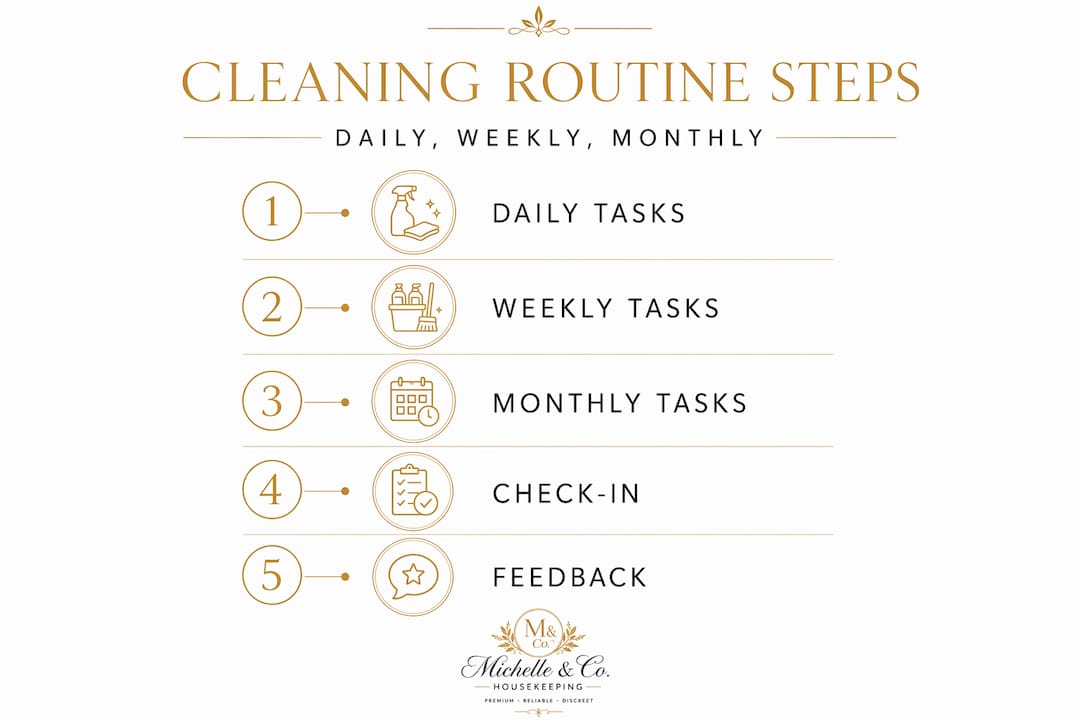
Dividing cleaning responsibilities into daily, weekly, and occasional categories gives your helper a clear sense of priority without overwhelming them. Here is how to structure it:
- Daily tasks cover the non-negotiables: surface wiping, vacuuming high-traffic areas, bathroom checks, kitchen cleaning after meals, and tidying communal spaces
- Weekly tasks include deeper work such as mopping all floors, cleaning bathrooms thoroughly, changing bed linen, and laundering household items
- Occasional tasks cover things like cleaning inside appliances, washing windows, organising cupboards, and seasonal deep cleans
Many homeowners make the mistake of treating all tasks as equally urgent. They are not. Hotel-standard bathroom cleanliness and guest-ready reception rooms should be treated as high-priority standards, maintained daily. Storage rooms and utility areas can tolerate a less frequent schedule.
Visual task charts placed in the kitchen or utility room remove the need for daily verbal instruction. A simple laminated checklist, organised by frequency and room, gives your helper a reference point and gives you a way to verify completion without hovering.
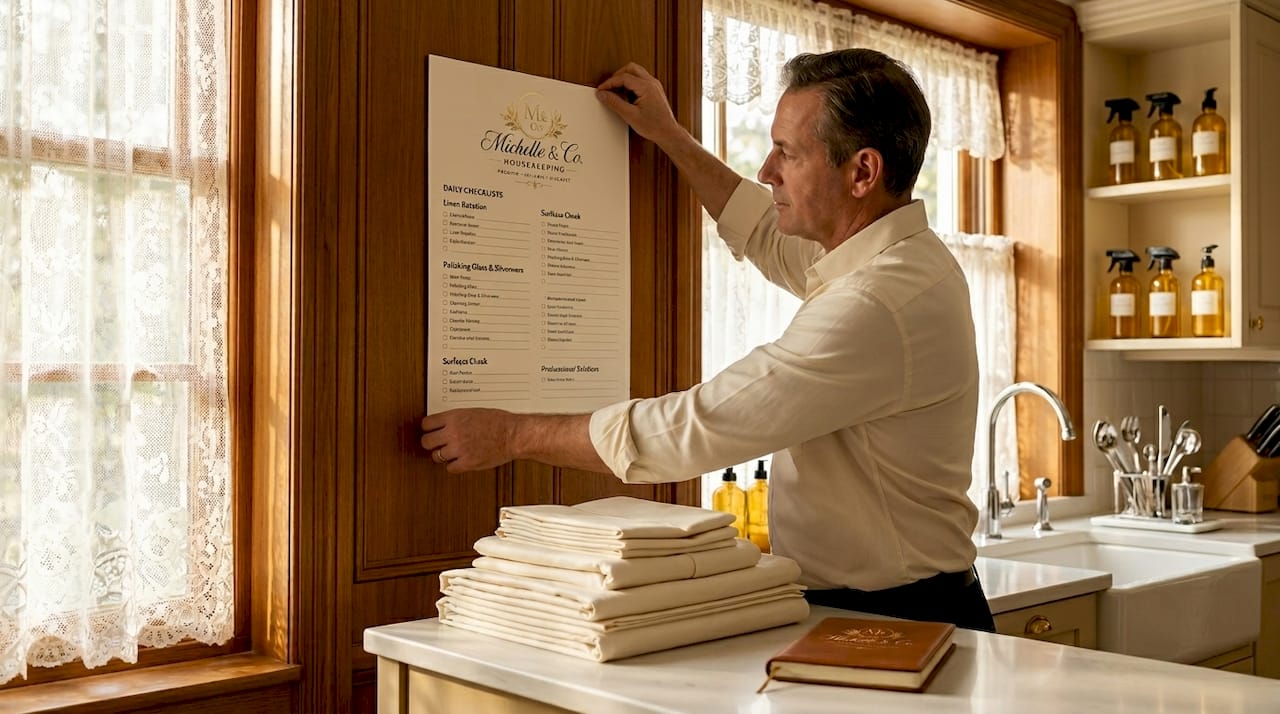
Pro Tip: Avoid changing expectations frequently. Shifting priorities without notice is one of the most common causes of inconsistency. If your standards or schedule change, update the written chart and discuss it directly rather than raising it as a complaint after the fact.
Communication pathways also need to be systematised. Decide in advance how your helper should raise issues: a daily notes book, a shared checklist with a notes column, or a brief morning check-in. The method matters less than the consistency.
Communication and performance verification
Even the best-prepared arrangement will develop friction without a structured communication system. Documented communication protocols and regular feedback are what separate households that maintain high standards from those that gradually slip.
Weekly performance reviews do not need to be formal or uncomfortable. A ten-minute conversation at the end of the week, reviewing what went well and what needs adjustment, is enough to maintain accountability on both sides. Use this time to:
- Acknowledge tasks completed to a high standard
- Clarify any areas where expectations were not met, with specific examples
- Adjust the task chart if workload has shifted
- Address any resource issues, such as supplies running low or equipment needing replacement
- Invite your helper to flag anything that is making their work harder
Cleaning checklists with completion tracking make performance verification straightforward. When a task is ticked off daily, patterns become visible quickly. If bathrooms are consistently unchecked on Tuesdays, that is a scheduling issue to solve, not a disciplinary one.
One of the most underrated aspects of managing live-in cleaning support is defining autonomy clearly. Your helper needs to know which decisions they can make independently and which require your input.
An explicit framework distinguishing tasks helpers decide independently from those requiring employer check-in is key to cleanliness consistency and helper confidence.
For example, your helper should feel empowered to reorder a cleaning product when it runs low, but should check with you before rearranging a room or discarding anything. This clarity removes hesitation and speeds up the work considerably.
Protecting your helper's wellbeing
This section is one that many homeowners overlook, and it is the one most likely to determine whether your arrangement succeeds long-term. The benefits of live-in help depend entirely on the helper being in a position to perform well. Burnout is the single greatest threat to that.
About 90 employers are penalised annually for failing to provide mandatory rest days to domestic workers. Beyond the legal risk, the practical consequences are significant. A helper working without adequate rest will produce declining quality, make more errors, and eventually leave. The cost of replacing and re-onboarding a live-in housekeeper far exceeds the inconvenience of scheduling a day off.
Consider these principles as non-negotiable:
- Provide at least one full rest day per week, agreed in writing from the outset
- Define working hours clearly and avoid routinely extending them without compensation
- Respect personal time and private accommodation as genuinely off-limits
- Acknowledge good work regularly. Recognition is low-cost and high-impact
- Monitor workload honestly. If the home's demands have grown, adjust expectations or hours accordingly
Rest-day compliance and defined work hours indirectly sustain household cleanliness by reducing helper burnout and turnover. The most consistent homes are those where the helper feels respected, not just employed.
Common mistakes that undermine cleanliness
Even homeowners who prepare thoroughly can fall into patterns that gradually erode the arrangement. Recognising these early makes them far easier to correct.
- Unclear or shifting expectations. If your standards change without notice, your helper cannot meet them. Document changes and discuss them directly.
- Inadequate tools and supplies. Expecting high standards without providing the right products is a recipe for frustration on both sides. Audit your cleaning supplies regularly.
- No visual aids or written routines. Verbal instructions are forgotten. A labelled supplies and mapped storage system reduces interruptions and supports thorough, independent cleaning.
- Overworking without scheduled breaks. Fatigue compounds over time. A helper who is consistently overworked will not maintain the same standard in week twelve as they did in week one.
- Ignoring early signs of communication breakdown. If your helper stops flagging issues or asking questions, that is not a sign that everything is fine. It is often a sign they have stopped feeling comfortable raising concerns. Address this early.
My perspective on what actually works
I've seen arrangements that look perfect on paper fall apart within two months, and I've seen far simpler setups run beautifully for years. The difference is almost never about the helper's capability. It is about the system the homeowner builds around them.
In my experience, the homeowners who maintain the highest standards are not the ones who check in most frequently. They are the ones who invest the most time in the first two weeks. They walk through every room, explain every preference, and hand over a written reference the helper can return to without asking. After that, they step back and trust the system.
The other thing I've learned is that empathy is not a soft skill in this context. It is a practical one. When a helper feels genuinely respected, they take ownership of the home's cleanliness in a way that no checklist can manufacture. I've watched helpers go well beyond their task list because they felt valued. That discretionary effort is what turns a clean home into an exceptionally well-kept one.
What I'd caution against is the instinct to tighten control when standards slip. Nine times out of ten, slipping standards signal a communication gap, not a performance problem. Revisit the system before you revisit the conversation.
— Simon
How Michelleandcohousekeeping supports homeowners

If you are working with live-in help or considering it, Michelleandcohousekeeping offers professional housekeeping services across Cheshire, including Wilmslow, Alderley Edge, and Knutsford, that complement your existing arrangements. Whether you need a regular deep clean to supplement your helper's daily routine, a one-off refresh before guests arrive, or a structured cleaning programme to set the standard your helper can then maintain, the team at Michelle & Co. Housekeeping delivers results to a consistently exceptional level.
Professional support is particularly valuable during the onboarding period, when establishing what "clean" looks like in your home sets the benchmark for everything that follows. To discuss your requirements and receive a tailored quote, visit the housekeeping quote page and take the first step towards a home that is always presented to its finest.
FAQ
What is the most important step before hiring live-in help?
Signing a detailed employment contract that covers duties, working hours, accommodation conditions, and rest days is the single most important step. It protects both parties and removes ambiguity from the outset.
How do I maintain cleanliness standards without micromanaging?
Create written task charts divided by frequency, provide labelled supplies and a storage map, and hold brief weekly check-ins. These systems allow your helper to work independently while keeping you informed of progress and issues.
How often should a live-in housekeeper have a rest day?
At least one full rest day per week is the standard requirement in most jurisdictions. Providing this consistently protects your helper's wellbeing and sustains the quality of their work over the long term.
What should I do if cleaning standards start to slip?
Review your communication system before drawing conclusions about performance. Slipping standards most often indicate a gap in instructions, supplies, or scheduling rather than a lack of effort. Revisit the task chart and hold a direct, constructive conversation.
Can professional cleaning services work alongside live-in help?
Yes. Professional services such as those offered by Michelleandcohousekeeping can handle periodic deep cleans or specialist tasks, setting a high benchmark that your live-in housekeeper can then maintain on a daily basis.