

Most people assume home maintenance cleaning means setting aside an entire weekend to tackle a mountain of chores. That assumption is what makes the whole idea feel so unappealing. In reality, what is home maintenance cleaning comes down to something far more manageable: a set of scheduled, purposeful tasks that prevent wear, protect your health, and preserve the value of your home. The professional term for this practice is preventive home care, and when it is structured correctly, it takes far less time than most people expect.
Table of Contents
- Key takeaways
- What home maintenance cleaning actually means
- Cleaning frequencies: what to do and when
- Expert techniques that make cleaning faster
- Health and safety tasks that cannot be skipped
- My perspective on what most people get wrong
- Professional support for your home care routine
- FAQ
Key takeaways
| Point | Details |
|---|---|
| Cleaning is preventive care | Routine upkeep stops minor issues becoming costly repairs or health hazards. |
| Frequency determines effort | Breaking tasks into daily, weekly, and monthly slots keeps each session short and manageable. |
| Top-down and zone methods work | Systematic approaches reduce wasted effort and prevent surfaces being re-contaminated. |
| Health and safety depend on it | Replacing filters, testing detectors, and auditing medicine cabinets protect everyone in the home. |
| Small habits protect property value | Consistent maintenance reassures buyers and supports a stronger sale price. |
What home maintenance cleaning actually means
Home maintenance cleaning is the practice of carrying out scheduled cleaning and upkeep tasks to prevent deterioration, reduce health risks, and keep a property in good condition over time. It sits somewhere between your daily tidy and a full structural survey. Think of it as the layer of care that sits in between.
The financial case for this approach is straightforward. Homeowners should budget 1 to 4% of their property's value annually for maintenance to protect equity and avoid system failures. For many homeowners in Cheshire, that is a meaningful sum. Neglecting routine upkeep tends to turn small problems into expensive ones.
Beyond money, there is a clear health argument. A tidy, well-maintained living environment reduces allergens, mould, and bacteria. It also has a measurable effect on mental wellbeing. Clutter and grime create low-level stress that accumulates quietly. Addressing them consistently removes that background noise from daily life.
The core tasks of home maintenance cleaning include:
- Dusting and surface care across all rooms, including neglected areas such as skirting boards and light fittings
- Appliance maintenance, including cleaning filters, seals, and vents to extend working life
- Safety checks, such as testing smoke detectors and inspecting caulking around baths and sinks
- Minor repairs, such as tightening loose fixtures or replacing worn seals before they cause damage
- Plumbing awareness, including checking under sinks for slow leaks and monitoring water pressure
Each of these sits within a broader home upkeep checklist that, when followed consistently, keeps the home running smoothly without crisis management.
Cleaning frequencies: what to do and when
The most practical way to approach home hygiene maintenance is to organise tasks by frequency. This prevents the overwhelming feeling of trying to do everything at once, and it keeps each session short enough to fit into ordinary life.
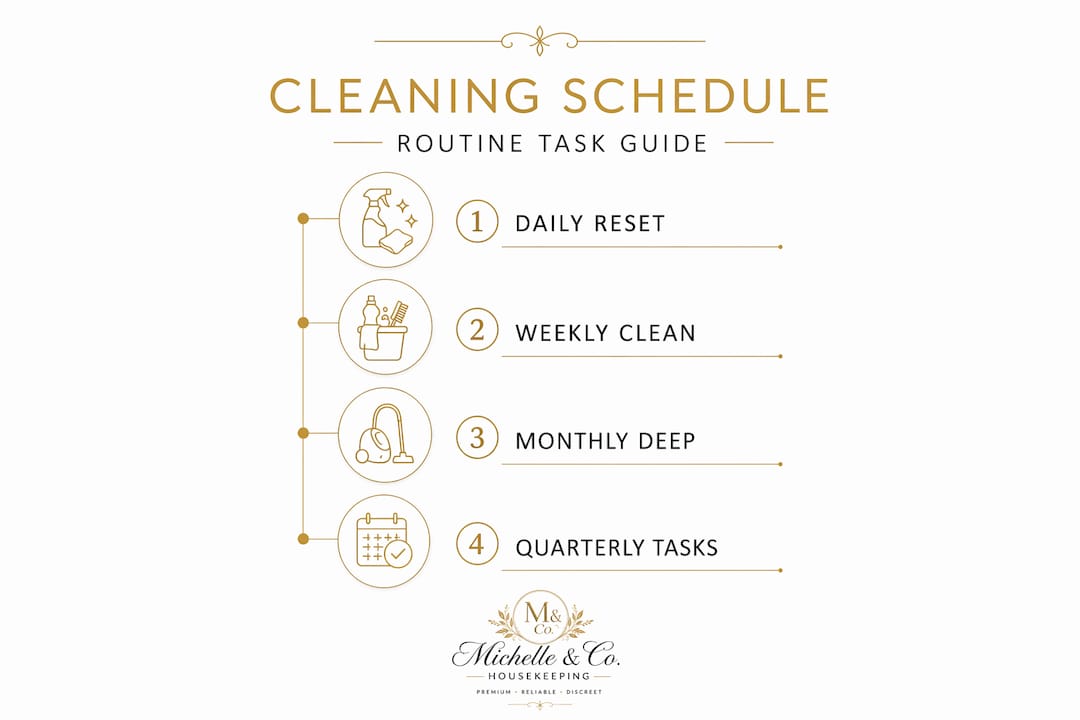
Structured scheduling improves consistency and reduces effort significantly. Monthly tasks typically take around 15 minutes; quarterly tasks around one hour. That is far less time than most people assume.
Here is a realistic breakdown of how to clean your home across different time frames:
- Daily (10 to 15 minutes). Wash dishes or run the dishwasher, wipe kitchen surfaces, do a clutter reset in main living areas, and hang or fold any clothing left out. These micro-habits prevent build-up.
- Weekly (60 to 90 minutes). Vacuum and mop floors, clean bathrooms thoroughly, change bed linen, wipe down kitchen appliances, and empty all bins.
- Monthly (15 to 30 minutes). Check plumbing under sinks, test smoke detectors, replace or check HVAC filters, clean the inside of the microwave and oven, and wipe down the insides of kitchen cupboards.
- Quarterly (1 to 2 hours). Clean gutters, inspect caulking around baths, showers, and windows, service appliances, and deep clean the oven and extractor fan.
- Seasonally (half a day). Wash windows inside and out, inspect the roof and loft space, check external drains, rotate mattresses, and launder curtains or blinds.
| Task | Frequency | Approximate time |
|---|---|---|
| Surface wipe and clutter reset | Daily | 10 to 15 minutes |
| Floors, bathrooms, linen change | Weekly | 60 to 90 minutes |
| Smoke detector test, filter check | Monthly | 15 to 30 minutes |
| Gutter clean, caulking inspection | Quarterly | 1 to 2 hours |
| Window wash, roof and drain check | Seasonally | Half a day |
Pro Tip: Set a recurring reminder on your phone for monthly and quarterly tasks. It takes the decision out of the equation entirely, which is the single biggest barrier to consistency.
Expert techniques that make cleaning faster
Knowing what to clean matters. Knowing how to clean efficiently matters just as much. There are several methods used by professional housekeepers that dramatically reduce wasted effort.
The top-down cleaning rule is one of the most effective. You start at the highest point in a room, whether that is a ceiling fan, a high shelf, or a light fitting, and work downwards. Dust and debris fall to lower surfaces as you clean, which means you capture everything in a single pass rather than re-contaminating areas you have already cleaned.

Zone cleaning is equally powerful. Rather than moving randomly from room to room, you divide the home into defined areas and complete each zone fully before moving to the next. Professional organisers consistently recommend this approach to reduce decision fatigue and improve efficiency. When you know exactly where you are starting and finishing, the task feels contained rather than endless.
A few additional techniques worth adopting:
- Let products do the work. Allowing cleaning products to soak for the recommended time reduces scrubbing effort significantly. Soaking extractor fan filters for an hour, for example, makes degreasing almost effortless.
- Use a clockwise pattern. Professional crews use a systematic clockwise room pattern to cover every surface without missing spots. This method reduces the need to re-clean by over 80%.
- Dryer sheets for dust control. Attaching dryer sheets to an extended roller captures dust on baseboards and ceiling fans far more effectively than a standard cloth.
- Batch similar tasks. Clean all glass surfaces across the whole house in one pass, then move to all wooden surfaces. Switching between task types wastes time and mental energy.
Pro Tip: Keep a small caddy stocked with your most-used products in a central location. Removing the friction of gathering supplies before each session makes it far easier to start.
Health and safety tasks that cannot be skipped
Some home maintenance cleaning tasks carry consequences that go well beyond aesthetics. These are the checks and replacements that directly affect the safety and health of everyone in the home.
Shower curtains and liners should be replaced or deep cleaned every three months. Mould and bacteria accumulate on them quickly, particularly in bathrooms with limited ventilation. It is one of the most overlooked sources of indoor air contamination.
Medicine cabinets deserve attention every six months. Expired medications are not merely ineffective; some become chemically unstable over time. Auditing and safely disposing of out-of-date products is a straightforward task that many households skip entirely.
Air filter replacement is one of the highest-impact maintenance tasks you can carry out. A clogged filter recirculates dust, allergens, and bacteria through the home continuously. Replacing filters on schedule is one of the simplest ways to improve indoor air quality without any specialist knowledge.
Smoke detector maintenance is non-negotiable. Testing alarms monthly and replacing units that are more than ten years old reduces fire death risk by 60%. It takes less than two minutes per month and is the single most important safety task on any home upkeep checklist.
Wastewater disposal also warrants consideration. Cleaning and maintenance activities generate chemical waste, and responsible disposal of this wastewater protects local water supplies. Pouring cleaning chemicals down outdoor drains is not a neutral act.
My perspective on what most people get wrong
I have seen a consistent pattern across years of working in and around premium home care. The people who struggle most with home maintenance are not the ones who lack time. They are the ones who treat cleaning as a single, large event rather than a series of small, unremarkable habits.
The idea that a home needs a major overhaul every few months is, in my view, one of the most counterproductive beliefs in domestic life. It creates a cycle of avoidance followed by exhaustion. The home deteriorates quietly, the task grows, and the reluctance grows with it.
What I have found actually works is almost boring in its simplicity. A fifteen-minute reset each evening. A focused weekly clean of no more than ninety minutes. Monthly checks that take less time than a coffee break. When these habits are in place, the home never reaches the point where a large intervention is needed.
The hidden cost of neglecting this is financial as well as emotional. A home that shows evidence of consistent care sells faster and at a stronger price. Beyond the market value, there is something quieter at stake. Living in a well-maintained space changes how you feel in it. That is not a small thing.
The goal is not perfection. It is a sustainable rhythm that protects your home and your peace of mind without consuming your weekends.
— Simon
Professional support for your home care routine

Even the most organised homeowner benefits from professional support at certain points in the year. Whether you need a thorough deep clean before a seasonal reset, a reliable regular housekeeper to maintain your standards between your own sessions, or an end-of-tenancy clean that leaves a property in exceptional condition, Michelleandcohousekeeping offers precisely that level of service across Cheshire, including Wilmslow, Alderley Edge, and Knutsford.
Every service is tailored to the individual home and carried out with the discretion and attention to detail that a well-presented property deserves. If you are ready to take the effort out of maintaining your home to an exceptional standard, request a bespoke quote and find out how professional housekeeping can complement your existing routine.
FAQ
What is home maintenance cleaning?
Home maintenance cleaning is the practice of carrying out scheduled cleaning and upkeep tasks to prevent deterioration, protect health, and preserve property value. It covers everything from daily surface wiping to seasonal appliance servicing and safety checks.
How often should you carry out routine home maintenance?
Core tasks should be divided into daily, weekly, monthly, and quarterly sessions. Monthly tasks take around 15 minutes and quarterly tasks around one hour, making consistent upkeep far less demanding than most people expect.
Why is home cleaning important for health?
Regular cleaning removes allergens, mould, and bacteria from the living environment. Replacing air filters, cleaning shower curtains every three months, and testing smoke detectors monthly are among the most impactful health-related maintenance tasks.
What is the most efficient way to clean a home?
Professional housekeepers recommend the top-down rule, zone cleaning, and a clockwise room pattern. These three methods together prevent re-contaminating cleaned surfaces and reduce the time needed to cover every area thoroughly.
Can regular cleaning protect my property value?
Yes. Consistent maintenance, including roof and gutter care, fresh caulking, and visible upkeep, reassures buyers and supports a faster sale at a stronger price.